
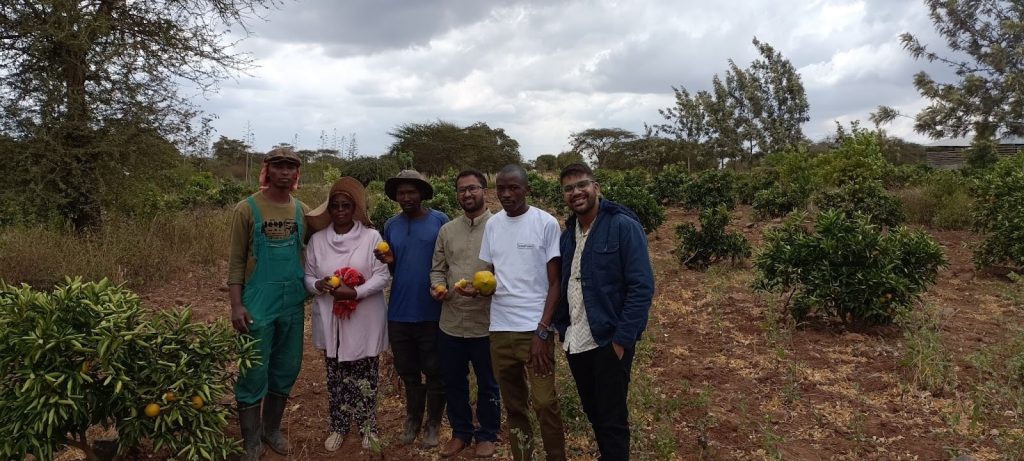
At Enviu, we believe in the power of collaboration because we understand that big goals often require diverse perspectives and experiences. This is why we’re all about cross-learning; an approach which becomes particularly crucial when tackling challenging problems that demand creative solutions. Ultimately this led to the creation of our Venture Builder Exchange Program.
In fact, a while back we spearheaded an exciting cross-cultural, venture builder exchange when Anurag Jain and Pratheek Abraham, the venture builders of Enviu’s Reweave Program in India, jet-setted to our Nairobi office for a captivating exchange of ideas and experiences. Simultaneously, Brenda Nambatya, a venture builder from Enviu’s FoodFlow Program in Kenya was gearing up to take the lead in our India ideation and validation sprint at our Bangalore office, creating a dynamic exchange of insights and perspectives.
We found it interesting that despite their geographical differences, India and Kenya are driven by youthful populations, technological innovation, and a strong spirit of entrepreneurship. You’ll notice they face similar systemic issues when you peek into their supply chains. But what grabs you is how each country office tackles these issues in its own distinct way.
After a whirlwind period of idea and culture exchanges, everyone returned and the dust finally settled. We then contacted our venture builders to uncover the learnings they had documented. The learnings touched on the professional as well as personal development side.
Navigating Kenya’s Entrepreneurial Plains
Upon touching down in Kenya, Anurag and Pratheek quickly sensed the entrepreneurial vibe deeply woven into the local culture. The lively matatu scene, bursting with creative designs and entrepreneurial flair, along with the traditional street-side businesses fostering community commerce, instantly captivated the duo.
Once at the office, they dived headfirst into the day-to-day operations of East Africa. This included brainstorming with the Kenyan venture builders and delving into how the Kenya team applied Enviu’s methodology to ventures like SokoFresh and Shambani Pro. Field visits were also on the agenda, offering Anurag and Pratheek a firsthand look at the challenges in smallholder supply chains, such as inefficient storage, prolonged distribution times, and the lack of market access leaving smallholder farmers in an endless cycle of poverty.
A standout moment of their visit was the tour of Uptex, a fellow Reweave venture in Kenya. Uptex focuses on reducing post-consumer textile waste and has already secured partnerships to extend its impact globally. Anurag and Pratheek represented their Reweave team in India, poised to launch a promising program centered on upcycling post-consumer textile waste.

The visit’s conclusion brought together Kenyan and Indian cultures. The ambiance was vibrant, with electric music setting the tone. The Kenyan team organized an informal naming ceremony, christening Anurag “Munyambu” (meaning Lion) and Pratheek “Wambua” (signifying “born in the rain” due to his birth in the rainy season). As a parting gesture, the Kenya team presented the duo with funky tea shirts as souvenirs.
Looking ahead, Anurag and Pratheek’s next steps involved returning home to the India team, sharing the valuable insights gained during their visit, and eagerly anticipating the upcoming visit of Kenya Venture Builder Brenda Nambatya. Brenda would lead them through an Ideation Sprint, laying the groundwork for The Reweave Program’s potential, system-changing business models.
Lessons from Kenya
(Anurag and Pratheek)
- Keep pitching your vision: As a venture builder, you have a unique and innovative idea of creating a venture studio that combines social impact and business objectives. Constantly pitch it to different audiences to convince them of its viability and value.
- Be realistic and transparent: Dual missions of creating social impact and business value can create tension. Set realistic goals, communicate clearly, and be transparent about challenges to build trust and alignment with stakeholders.
- Validate, do not build: Before building ventures, validate the idea, business model, and assumptions. Use both ‘top-down’ dreaming and ‘bottom-up’ doing to build an economy that serves people and the planet.
- Manage Donor and Investor Expectations: Regularly communicate project progress, challenges, and plans with donors and investors. Be transparent to build trust and manage expectations effectively.
- Optimise Time and Cost (Be Lean): Adopt a lean approach to idea validation. Start with minimal resources, create prototypes or MVPs to gather feedback quickly and cheaply, and refine your idea efficiently.
- Identify and Nurture Relationships with Investors: Gradually build relationships with potential investors, approaching them when your venture can demonstrate value. Timing is crucial to maximise the chances of securing funding.
- Be Prepared to Kill a Venture Idea: Approach ventures with adaptability. Set clear criteria for success and failure and be willing to cut losses and move on to another idea if a venture consistently falls short. Avoid emotional attachment and be objective about project viability to use resources wisely.

Diving Into the Heart of India’s Silicon Valley
Exploring India’s post-consumer textile value chain alongside the India team proved to be a revelation for Brenda, offering profound insights into the gaps, potential solutions, and the transformative systemic changes achievable through the resulting business ventures from the Ideation session.
The collaborative brainstorming session was a vibrant exchange, fostering divergent thinking to breathe life into the boldest and most innovative concepts, while also skillfully guiding the convergence of ideas towards actionable solutions.
Beyond mere ideation, Brenda seized the opportunity to engage deeply with her fellow venture builders. They exchanged experiences and confronted shared challenges such as embracing failure and the imperative of swift iteration. This emphasised the collective journey towards problem-solving rather than attachment to any particular business idea.
Adding a cultural dimension to her experience, Brenda joined in the festivities of Ganesh Chaturthi, a festival that celebrates the birthday of Lord Ganesha, the Hindu god of wisdom and success. During the festival, she experienced firsthand the richness of Indian traditions and fostered stronger bonds with her colleagues.
Lessons from India
Reflecting on her experience, Brenda summarised her key takeaway:
Navigating the realm of startups and innovation is ambiguous, unpredictable, and filled with uncertainty. However, with the right problem statement, a cohesive team, an open mindset, and trust in the process, the journey becomes manageable, and success becomes attainable.”

Brenda continues:
…The team’s enthusiasm in tackling waste in the textile space, along with their incredible dedication, curiosity, and open-mindedness during every session, made a lasting impression. Their warmth and hospitality continued, giving me a genuine Bengaluru experience, even during those long 12-hour workdays! Most importantly, we crafted INCREDIBLE concepts dedicated to addressing the inefficiencies in post-consumer textile waste collection and management in India, all while generating more job opportunities.
Charting a Bold Course Towards Sustainable Textile Practices
By harnessing the insights gathered from this cross-continental exchange, we are better positioned to innovate systemic solutions that drive the textile industry toward circularity and sustainable practices, while creating impactful, job-generating ventures.
Since its inception, Enviu has believed in the power of collective action to solve the most pressing global issues. Through initiatives like the Venture Builder Exchange, we’re bridging cultural and geographical divides to co-create ventures that serve both people and the planet. With every new exchange, venture, and partnership, we’re building a foundation for a more equitable and sustainable world.
